The CAPTCHA Economy: How WAFs Integrate Challenges in 2026 (and Why Bypasses Cost Less Than Protection)
Every website is getting scraped. CAPTCHAs are one answer, but the landscape has fragmented: Google reCAPTCHA lost its monopoly, Cloudflare Turnstile runs free (sort of), and bypass services solve them for less than Google charges for Enterprise assessments. Meanwhile, WAFs are adding native CAPTCHA challenge actions. This post maps the whole picture: the providers, the pricing, the bypass economics, and which WAFs can actually issue a challenge today.

Every website is getting scraped. AI training crawlers, credential-stuffing bots, scalpers, LLM agents that ignore robots.txt and terms of service. If your site has data worth taking, someone is automating the collection of it.
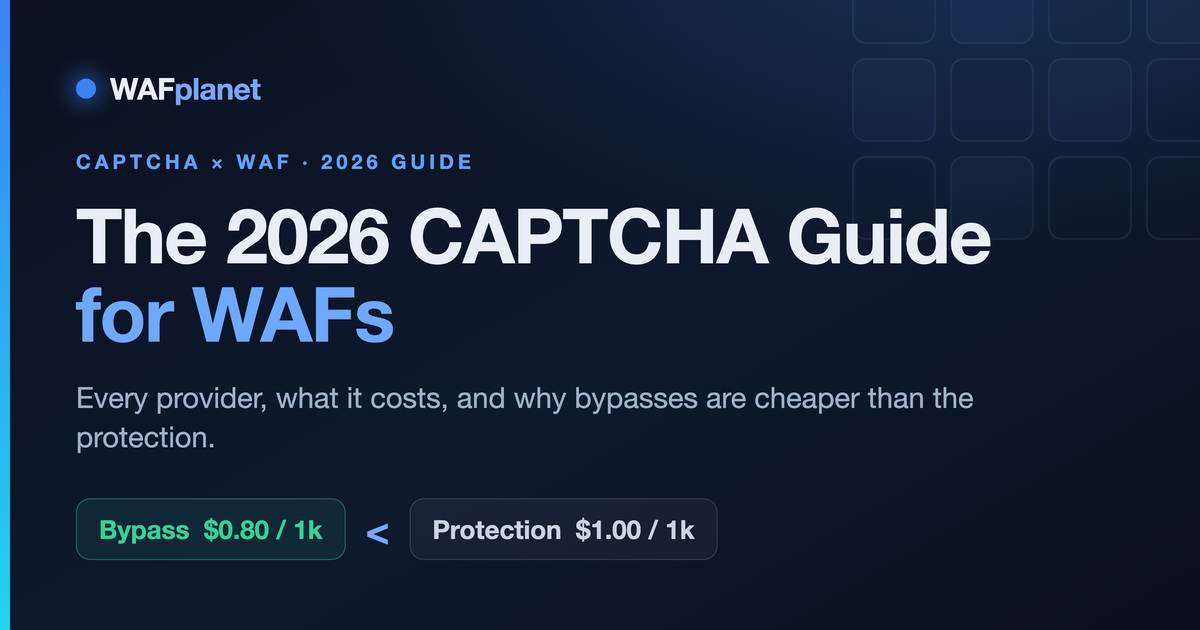
CAPTCHAs are one answer. They have been the answer for two decades, and they are still the answer Google, Cloudflare, AWS, and Microsoft embed into their WAFs as a native enforcement action. But the landscape has shifted in ways that make the old assumptions dangerous. A bypass service will solve a reCAPTCHA v2 for $0.80 per thousand using an AI model, faster than a human can tick the "I am not a robot" box. Google charges the site owner $1 per thousand for the Enterprise version of the same challenge. The protection now costs more than the bypass.
This post maps the full picture: every major CAPTCHA provider, what they cost, the bypass economy, which WAFs can issue a CAPTCHA challenge natively, and when you should use one instead of a lighter alternative.
The provider landscape in 2026
The CAPTCHA market looks nothing like it did three years ago. Google reCAPTCHA still holds the dominant share. Market intelligence platforms put it at 99.92% of the CAPTCHA category with 5.6 million detected deployments. But alternatives have matured, and the self-hosted segment is getting serious attention from privacy-conscious operators.
Google reCAPTCHA (v2, v3, Enterprise)
Still the default, but the cracks are showing. Google migrated reCAPTCHA to its Google Cloud Platform in 2025, which changed the pricing model and added a billing requirement even for the free tier. reCAPTCHA Essentials gives you 10,000 free assessments per month per organization, then $8 per month for 10,001 to 100,000, then $1 per 1,000 beyond that. Enterprise is a flat $1 per 1,000 with a monthly commitment.
Three versions co-exist: v2 (interactive checkbox with optional image grid), v3 (invisible score from 0.0 to 1.0), and the Enterprise tier that adds account defender, transaction protection, and 11 scoring levels. The privacy cost is real: reCAPTCHA collects behavioral data, device fingerprints, and browsing signals that feed Google's ad ecosystem. The hCaptcha analysis puts the value of a single reCAPTCHA training signal at $0.001 or less, meaning Google's "free" tier is anything but.
Cloudflare Turnstile
Turnstile was marketed as the frictionless, privacy-first alternative. It runs lightweight JavaScript checks in the background, evaluates browser signals and device characteristics, and returns a verification token. Most users never see a challenge. Three modes exist: non-interactive (fully invisible), non-intrusive interactive (a clickable widget), and invisible (no visible element at all).
Pricing is the confusing part. Cloudflare markets Turnstile as "free" and provides a free tier with up to 20 widgets and unlimited challenge volume. At scale, however, you hit an enterprise wall: the only paid option above the free tier is a custom Enterprise contract, typically starting above $2,000 per month, with no self-serve mid-tier. If your traffic grows beyond what the free tier comfortably handles, you either stay on it or negotiate a contract. Cloudflare's product page emphasises the free tier; the enterprise pricing requires a sales conversation.
Privacy is genuinely better than reCAPTCHA: Turnstile does not harvest data for advertising. But it does collect behavioral signals (mouse movements, interaction timing) that may still require GDPR justification depending on your jurisdiction. hCaptcha's research claims Turnstile is cheaper to bypass than reCAPTCHA v3, suggesting Cloudflare prioritised UX friction over detection strength.
hCaptcha
Positioned as the privacy-friendly reCAPTCHA replacement, hCaptcha uses image-based challenges and is API-compatible with reCAPTCHA (making it a drop-in swap). In practice, the challenges take 3 to 10 seconds, which puts it in the same UX bucket as reCAPTCHA v2. Privacy is better than Google's but not clean: hCaptcha still collects interaction data, which it monetises by using human solves to label AI training data. The "free" pricing is subsidised by that labelling arrangement, and paid plans exist for high-volume sites.
Friendly Captcha
This takes a fundamentally different approach: proof-of-work instead of puzzles. The browser solves a lightweight cryptographic challenge in the background while the user fills out the form. There is no tracking, no behavioral data collection, no Google dependency. Privacy-first by design and GDPR compliant out of the box. Pricing starts with a free tier and scales from there. The tradeoff: proof-of-work has a battery impact on mobile, and the puzzle difficulty must be adaptive to stay effective against automated solvers.
Arkose Labs (FunCaptcha)
Enterprise-only gamified challenges: rotating 3D objects, image matching, spatial puzzles. The adaptive difficulty engine escalates challenge complexity in real time based on risk signals, making it one of the hardest CAPTCHAs to solve at scale. The flip side: enterprise contracts only, meaning you cannot self-serve, and the interactive challenges add meaningful friction when triggered. Arkose is not a choice for small sites; it is an insurance policy for high-value transaction flows (finance, gaming, large e-commerce).
GeeTest
Adaptive challenges (sliders, icon clicks, space puzzles) backed by seven layers of behavioral analysis. Claims an average verification time of 1.4 seconds and 360,000+ enterprise customers. Enterprise pricing on request, no public self-serve.
Self-hosted CAPTCHAs (ALTCHA/Sentinel, Cap.js, mCaptcha, Anubis, Private Captcha)
A growing category for sites that cannot or will not send their traffic data to a third party. Private Captcha's 2026 comparison is the most detailed breakdown of this space. The notable options:
- ALTCHA / Sentinel: The old Altcha (MIT licensed) is effectively abandonware. The current product is Sentinel, a proprietary proof-of-work system at €99 or €799 per month. The Docker image is 1.1 GB (407 MB of that is node_modules). Rich feature set including form provider, spam detection, and link redirects, but the security posture of a 1 GB self-hosted appliance is questionable.
- Cap.js: Lightweight proof-of-work (Apache 2.0). Runs on JavaScript and Redis, deployable in minutes. No dynamic difficulty scaling, no persistent storage, limited to JS frontends. Great for a Raspberry Pi, not for a production site under active scraping.
- mCaptcha: Proof-of-work, open source. Community driven.
- Anubis / Wicketkeeper: Proof-of-work challenges, free and self-hosted.
- Prosopo: Hybrid proof-of-work, self-hosted or proprietary.
- Private Captcha: Self-hosted with PoW and challenge options. The blog is from the provider itself, so treat comparisons with that context.
The self-hosted segment shares one limitation: proof-of-work hurts mobile users disproportionately, requires adaptive difficulty to work against real attackers, and none of the open-source options match the detection sophistication of the cloud providers. They are a privacy-first choice, not a security-first one.
Beyond the major players, the long tail of the CAPTCHA market includes several regional and niche providers. Yandex SmartCaptcha (0.3% market share) is the leading option in Russian-language sites, offering both invisible and interactive modes. Tencent Captcha (0.04%) and NetEase Yidun serve the Chinese market with slider and behavioral challenges. MTCaptcha (0.03%) positions itself as a GDPR-compliant enterprise option with accessibility features. BotDetect (self-hosted, actively maintained, .NET/Java/PHP, works in China) and KeyCAPTCHA are smaller standalone offerings used primarily in legacy integrations. The 6sense list also tracks several names that are effectively dead: SolveMedia is parked and for sale, Are You a Human redirects to a domain parking page, sweetCaptcha has been overtaken by an unrelated blog, and NoMoreCaptchas and Captch Me no longer resolve. None of these challenge the top three by market share, but the active ones matter for sites with regional or compliance-specific requirements.
What everything costs
| Provider | Free tier | Paid tier | Enterprise |
|---|---|---|---|
| Google reCAPTCHA | 10,000/mo (per org) | $8/mo (10K-100K), then $1/1K | $1/1K, monthly commitment |
| Cloudflare Turnstile | Yes (20 widgets, unlimited challenges) | None (no mid-tier) | Custom (~$2K+/mo) |
| hCaptcha | Yes (subsidised by data labelling) | Paid plans available | Custom |
| Friendly Captcha | Yes | Scaled plans | Custom |
| Arkose Labs | No | No (enterprise only) | Custom |
| GeeTest | No | No (enterprise only) | Usage-based |
| ALTCHA Sentinel | 30-day trial | €99/mo | €799/mo |
| Cap.js / mCaptcha / Anubis | Free (self-hosted) | N/A | N/A |
The critical observation: every CAPTCHA provider charges the site, and the bypass services undercut that price. We will quantify that in the next section.
The bypass economy
CAPTCHAs are not a check that bots cannot pass; they are a cost that raises the price of automation. The bypass market has matured into a clear tiered structure with well-documented pricing.
Commercial solver services
2Captcha is the oldest and best-known: a human workforce that solves CAPTCHAs and returns tokens via API. Pricing ranges from €0.50 per 1,000 for simple image CAPTCHAs to €1.40 for Turnstile and €2.80 for high-score reCAPTCHA v3. FunCaptcha (Arkose) ranges from €1.40 to €50 per 1,000 depending on difficulty.
CapSolver is the AI-native alternative. It solves everything algorithmically without a human workforce, which gives it sub-10-second response times and effectively unlimited capacity. Their published rates: reCAPTCHA v2 at $0.80 per 1,000, Turnstile at $1.20, AWS WAF at $2.00, reCAPTCHA v3 Enterprise at $3.00 (targeting high scores of 0.7-0.9).
The full comparison table across solver services shows Anti-Captcha from $0.50 per 1,000 images, DeathByCaptcha from $0.99 per 1,000, and CapSolver from $0.40 per 1,000 tokens.
| Bypass service | reCAPTCHA v2 | Turnstile | reCAPTCHA v3 (high) | FunCaptcha | Type |
|---|---|---|---|---|---|
| 2Captcha | €0.99-2.80/1K | €1.40/1K | €2.80/1K | €1.40-50/1K | Human workforce |
| Anti-Captcha | $0.50/1K | Supported | Supported | Supported | Hybrid (humans+templates) |
| CapSolver | $0.80/1K | $1.20/1K | $3.00/1K | - | AI (automated) |
| DeathByCaptcha | $0.99/1K | Supported | Supported | - | Hyrbid (humans+OCR) |
Read the critical line again: Google charges $1 per 1,000 for reCAPTCHA Enterprise assessments. CapSolver charges $0.80 per 1,000 to bypass them. The protection now costs the site more than the bypass.
AI-powered open source bypass
The big shift in 2025-2026 is that you no longer need to pay a solver service. ai-captcha-bypass is a Python tool that uses GPT-4o or Gemini 2.5 Pro through Selenium to solve text CAPTCHAs, puzzle sliders, reCAPTCHA v2, and audio CAPTCHAs. It works by screenshotting the challenge, sending it to a vision model, and executing the returned action (mouse coordinates, text input, grid clicks).
Other tools: NopeCHA (browser extension, formerly open source, now closed, works with Selenium/Puppeteer/Playwright) and Buster (open source, uses speech recognition for reCAPTCHA audio challenges).
The implication: any moderately capable LLM with vision can now solve CAPTCHAs. The days where you needed a human farm or a training pipeline are over. This changes the threat model for every provider that relies on image-based or puzzle-based challenges.
How effective is the bypass?
A 2023 UC Irvine study found that roughly 50% of bot traffic already passes reCAPTCHA through various means. AI solvers now claim success rates above 90% on reCAPTCHA v2 and common puzzle CAPTCHAs. The practical reality is that CAPTCHAs remain effective against casual scraping and bulk automation (the attacker who does not want to pay per solve) but are not a reliable barrier against a motivated attacker with a budget.
The residential proxy blind spot
There is a gap in every CAPTCHA system that runs on IP reputation. Residential proxies are IP addresses from real home ISPs (Comcast, Vodafone, Deutsche Telekom) that have been repurposed as relay points. They come from three sources: compromised IoT devices running as SOCKS exit nodes, proxyware users (Honeygain, IPRoyal, Proxyrack) who install an app in exchange for money, and mobile proxy networks that rotate through carrier NAT pools. In all three cases the IP looks clean. It does not appear in any VPN database, data center ASN list, or threat intelligence feed because it belongs to a real subscriber at a residential address.
This breaks the detection pipeline that most WAF CAPTCHA systems rely on. reCAPTCHA v3 assigns a score partly based on IP reputation. Turnstile evaluates browser signals but routing through a residential exit node can normalize those. The IP itself triggers nothing. An attacker behind Bright Data or Oxylabs (the largest residential proxy brokers) can send requests from 50,000 clean home IPs across 150 countries, and none of them will look suspicious to a system that checks whether the IP belongs to a known datacenter ASN.
The bypass services already exploit this. When 2Captcha or CapSolver claims a client-side solve in under 10 seconds, the solver is often running behind a residential proxy network that does not raise flags at the challenge layer. The actual solver is invisible because the traffic arrives through a clean residential IP with plausible browser fingerprints.
What addresses this: Behavioral analysis that does not depend on IP reputation. HUMAN Security and Arkose Labs detect bot behavior through interaction patterns (mouse movement curves, timing anomalies, scroll behavior) rather than where the IP is registered. Peakhour specifically advertises residential proxy blocking as part of its AI-powered bot management layer, identifying proxy traffic through network fingerprinting and behavioral analysis. Cloudflare Bot Management scores requests across 40+ signals including TLS fingerprint, HTTP/2 settings, and browser characteristics that are harder to spoof than the source IP. reCAPTCHA Enterprise's account defender adds session-level behavioral history. None of these are foolproof, but they raise the cost of automation far above reCAPTCHA v2 with a clean IP.
Bottom line: If your only bot detection layer is "challenge visitors from datacenter IPs," you are already compromised. Residential proxies mean the challenge must happen at the behavioral layer, not the network layer. CAPTCHA is still useful, but it needs to sit on top of real bot management, not replace it.
WAF CAPTCHA integration: the main event
This is where the story changes. CAPTCHA used to be a standalone widget you pasted into your HTML. In 2026, the major WAF platforms have turned it into a native enforcement action: your WAF detects suspicious traffic and serves a challenge directly, without your application code needing to handle it. This is a significant architectural shift.
Cloud WAFs with native CAPTCHA
Cloudflare WAF + Turnstile
Cloudflare has the deepest integration. Turnstile is available as a standalone widget for any site, but it also integrates directly into Cloudflare WAF rules as a challenge action. The Turnstile + WAF + Bot Management pipeline can rate-limit, score requests, and serve a Turnstile challenge at the edge before traffic reaches your origin. The Pre-Clearance feature extends this to fetch/XHR requests, not just HTML form submissions. Turnstile is free at the widget level; Cloudflare WAF starts at $20 per month (Pro, billed annually; $25/month month-to-month).
AWS WAF + CAPTCHA / Challenge
AWS WAF has two native challenge actions: CAPTCHA and Challenge. The CAPTCHA action serves an interactive Amazon-hosted puzzle. The Challenge action is lighter: it runs a JavaScript proof-of-computation in the browser without user interaction. Pricing is granular: CAPTCHA at $4 per 10,000 attempts, Challenge at $0.40 per million responses. The Bot Control managed rule group ($10 per month per Web ACL plus $1 per million requests) can automatically apply CAPTCHA or Challenge based on bot category. This is the most granular CAPTCHA pricing model of any cloud WAF, and the Challenge action (sub-penny cost) is a viable always-on option for most endpoints.
Azure Front Door WAF + CAPTCHA
Azure Front Door WAF (Premium tier) offers a native Microsoft CAPTCHA challenge. When a WAF rule matches, it returns an interactive CAPTCHA page. Successful completion passes the request through to standard WAF rule processing. The Bot Manager Ruleset 1.1 can automatically apply CAPTCHA based on bot risk scoring. Usage-based pricing, part of Front Door Premium.
Google Cloud Armor + reCAPTCHA Enterprise
Google Cloud Armor integrates with reCAPTCHA Enterprise to serve challenge pages at the edge. Cloud Armor evaluates reCAPTCHA session tokens and can block or allow based on the risk score. The Bot Management add-on ties reCAPTCHA scoring to Cloud Armor's WAF rules. You pay reCAPTCHA Enterprise pricing on top of Cloud Armor costs.
Imperva, Akamai, Fastly, F5, Radware, Prophaze
All of these enterprise WAFs offer CAPTCHA challenge actions as part of bot management add-ons. The pattern is consistent: the base WAF detects anomalous traffic, the bot management module assigns a risk score, and the platform can respond with a CAPTCHA or JavaScript challenge at the edge. Pricing is enterprise-only and bundled into the bot management SKU. The specific implementations:
- Imperva serves CAPTCHA or JS challenges as part of Advanced Bot Protection.
- Akamai supports reCAPTCHA integration plus branded challenge pages via Bot Manager.
- Fastly offers dynamic client challenges via Bot Management (not on the Essential Next-Gen WAF plan).
- F5 Distributed Cloud includes JS challenge and CAPTCHA as part of Bot Defense.
- Radware and Prophaze include CAPTCHA as part of their WAAP bot management.
Self-hosted WAFs with CAPTCHA
If you self-host your WAF, the options are narrower but real.
BunkerWeb (free, open source)
BunkerWeb is the most flexible self-hosted option. Its USE_ANTIBOT setting supports seven different modes: turnstile, hcaptcha, recaptcha, mcaptcha, captcha (simple image challenge), javascript (proof-of-computation), and cookie (challenge-response cookie). The antibot state is persisted in a session cookie so returning users do not get re-challenged. This level of provider choice in a self-hosted WAF is unique. Free and open source, runs on Nginx.
SafeLine WAF (free, open source)
SafeLine includes an Anti-Bot Challenge that dynamically issues CAPTCHAs to suspicious clients. Part of its bot protection layer alongside rate limiting and IP blocking. The Hacker News overview of SafeLine confirms CAPTCHA challenges as a core feature. Free, self-hosted.
CrowdSec (free + paid tiers)
CrowdSec's Nginx bouncer supports CAPTCHA remediation: when an IP is flagged by CrowdSec's threat intelligence (either local signals or the community blocklist), the bouncer can return a CAPTCHA instead of a block. The CAPTCHA is served at the Nginx level, not at the application level. Also available as a Cloudflare Worker bouncer. Free tier covers community signals; paid Security Engine adds commercial threat intelligence.
RhinoWAF (free, open source)
Open source Go WAF for Traefik/Nginx with built-in hCaptcha integration. Privacy-focused, GDPR compliant. Less mature than the options above.
WAFs without native CAPTCHA
ModSecurity, Coraza, open-appsec, and NAXSI are rule engines, not enforcement proxies. They can detect attacks, but they cannot serve a CAPTCHA challenge to the client by themselves. To add CAPTCHA to one of these, you need a separate reverse proxy layer (Nginx, HAProxy) or an application-level integration. This is not a flaw in those tools, it is a deliberate architectural boundary, but it means they are not part of the CAPTCHA-as-WAF-action story.
When CAPTCHA helps and when it hurts
The conversion cost is real
A Stanford study found that CAPTCHA challenges can reduce form conversions by up to 40%. Baymard's classic usability analysis documents the reasons: users cannot read the challenge, do not understand why it exists, or find it insulting to be treated like a bot after they have already filled out a 10-field form. The friction compounds on mobile.
The invisible modes (reCAPTCHA v3, Turnstile non-interactive, Friendly Captcha PoW) mitigate this significantly. But none of them eliminate it entirely. v3 scores penalise VPN and proxy users. Turnstile sometimes forces visible challenges. PoW drains mobile batteries. Every CAPTCHA has a UX cost, and the cost is highest on the flows you care about most: registration, checkout, login.
CAPTCHA placement anti-patterns
The most common mistakes:
- Putting CAPTCHA on login: Blocks legitimate users, signals that you have a rate-limiting or credential-stuffing problem you should solve at a lower level.
- Not putting it on registration: Lets bots create accounts en masse, which then bypass the login CAPTCHA with valid credentials.
- Showing the same challenge every time: CAPTCHA should be risk-adaptive, or you are punishing every visitor for the behaviour of a few.
- Using interactive CAPTCHA for low-value actions: A newsletter signup does not need Arkose Labs. A password reset button does.
Where CAPTCHA is still the right tool
- Account registration (high-value target for bots)
- Password reset and account recovery flows
- High-value transactions (ticketing, limited inventory, financial transfers)
- Forms that attract spam (contact forms, comment sections on high-traffic sites)
- API endpoints where rate limiting alone is insufficient
Alternatives to CAPTCHA
For many endpoints, lighter alternatives are more effective than CAPTCHA and carry zero UX cost:
- Rate limiting: The first line of defence. Blocks bulk scraping by volume alone.
- JS challenges: AWS WAF Challenge and Cloudflare's JS challenge run a proof-of-computation in the browser. Invisible to users, cheap for the site, expensive for bots at scale.
- Honeypot fields: Invisible form fields that bots fill in but humans do not see. Trivial to implement, catches unsophisticated scrapers.
- Time-based checks: If a form submission arrives in under two seconds, it is almost certainly a bot. Bypassable but catches naive automation.
- Behavioral biometrics: Mouse movement, scroll patterns, typing cadence. Services like SilentShield aim for fully invisible verification, though the market is less mature than the major CAPTCHA providers.
- Proof-of-work: Browser computes a cryptographic puzzle. Friendly Captcha and ALTCHA use this. No tracking, no images, zero user friction, but higher mobile battery cost and server validation overhead.
- IP reputation + fingerprinting: Block known bad IPs and require additional verification from suspicious fingerprints. Services like FingerprintJS and the built-in reputation systems in Cloudflare, AWS, and Azure WAF provide this without any challenge.
Decision framework: which CAPTCHA + WAF combo for which scenario
| Scenario | WAF | CAPTCHA | Why |
|---|---|---|---|
| Small site, wants simple protection, no budget | Cloudflare (free tier) | Turnstile (non-interactive) | Free, minimal friction, good enough for most bots. Accept the enterprise pricing cliff at scale. |
| Mid-size e-commerce, runs on AWS | AWS WAF | AWS Challenge (for browse), CAPTCHA (for checkout) | Granular pricing, Challenge costs pennies. Use CAPTCHA only on the high-value cart/checkout flow. |
| EU-based, strict GDPR requirements | BunkerWeb or Cloudflare | Turnstile (non-interactive) or Friendly Captcha | Turnstile has no ad-tracking data flow. Friendly Captcha has no tracking at all. BunkerWeb gives you both options. |
| High-value transactions (finance, gaming) | Imperva, Akamai, Cloudflare Enterprise | Arkose Labs or reCAPTCHA Enterprise | Budget justifies enterprise pricing. Arkose is hardest to bypass; Enterprise reCAPTCHA has the best scoring granularity. |
| Self-hosted infrastructure, no cloud WAF | BunkerWeb or SafeLine | BunkerWeb: any provider. SafeLine: built-in CAPTCHA challenge | BunkerWeb is the most flexible. SafeLine is simpler. Both are free. |
| Privacy-maximalist, zero third-party data | BunkerWeb | mCaptcha (self-hosted PoW) or ALTCHA Sentinel | Your data never leaves your server. Accept lower detection quality vs cloud providers. |
| Already runs CrowdSec | CrowdSec bouncer (Nginx/Cloudflare) | CrowdSec CAPTCHA remediation | Free, fits existing CrowdSec deployment. CAPTCHA is triggered by threat intelligence signals, not every request. |
| API-heavy application | Any of the above | AWS Challenge or JS challenge (not CAPTCHA) | APIs cannot render visual challenges. Use proof-of-computation or token-based verification. |
The takeaway
CAPTCHA in 2026 is no longer a binary choice between "has it" and "does not." The market has stratified into three tiers: cloud WAFs with native challenge actions (Cloudflare, AWS, Azure, Google, Imperva, Akamai), self-hosted WAFs with CAPTCHA support (BunkerWeb, SafeLine, CrowdSec), and standalone widgets that do not integrate with your WAF at all.
The critical facts to carry away:
- Bypass is cheaper than protection. The solver services undercut Google's Enterprise pricing. Base your economics on this reality: CAPTCHA is a deterrent, not a wall.
- AI killed the image CAPTCHA. GPT-4o and Gemini 2.5 Pro can solve them. If your protection relies on image selection or text recognition, it is time to upgrade to behavioral or proof-of-work approaches.
- WAF-native CAPTCHA is better than a widget. When the WAF decides when to challenge, you avoid the "CAPTCHA on every form" anti-pattern. AWS Challenge at $0.40 per million is cheaper than serving reCAPTCHA JS to every visitor.
- Self-hosted is viable for privacy but weaker for security. The open-source options trade detection quality for data sovereignty. If your threat model includes motivated actors, a cloud CAPTCHA provider with AI-trained models and global threat intelligence will outperform anything you can run on your own hardware.
- CAPTCHA is one layer, not the whole stack. Rate limiting, IP reputation, fingerprinting, JS challenges, and WAF rules all come before the CAPTCHA decision. Use all of them, and deploy CAPTCHA only as the escalation point when the other signals are inconclusive.
The question is no longer "which CAPTCHA should I use." It is "at what point in my WAF rule evaluation should I challenge the client, and with which mechanism?" The answer depends on your WAF, your traffic profile, your compliance requirements, and how much you are willing to spend on the arms race.
Frequently Asked Questions
If bypass services undercut the price of protection, why bother with CAPTCHAs at all?
Because most attackers are not willing to pay per-solve. CAPTCHAs raise the floor: casual scraping, bulk automation, and drive-by bots bounce. The bypass economy only helps motivated attackers with a budget. For 90% of bot traffic, a CAPTCHA at $0 (native WAF challenge) is cost-effective even if $0.80 per 1,000 bypasses exist.
Which WAF has the best CAPTCHA pricing?
AWS WAF. CAPTCHA at $4 per 10,000 attempts, Challenge (JS proof-of-computation) at $0.40 per million responses. That is sub-penny. Cloudflare Turnstile is free for up to 20 widgets but hits a wall at enterprise pricing (~$2,000+ per month) with no self-serve mid-tier. Google Cloud Armor adds reCAPTCHA Enterprise costs ($1 per 1,000) on top of WAF pricing.
Is self-hosted CAPTCHA (mCaptcha, Cap.js, ALTCHA) a viable option?
For privacy-first sites, yes. For security-first sites, not really. Proof-of-work hurts mobile users, none match the detection sophistication of cloud providers, and the open-source options lack adaptive difficulty. The exception is BunkerWeb, which supports Turnstile, hCaptcha, reCAPTCHA, mCaptcha, JS challenge, and cookie challenge - all configurable in one self-hosted WAF.
Are AI vision models making CAPTCHAs obsolete?
Not yet, but the trend is clear. Tools like ai-captcha-bypass (GPT-4o, Gemini 2.5 through Selenium) solve text, puzzle slider, reCAPTCHA v2, and audio challenges with over 90% success. The 2026 shift is that you no longer need a human farm. This affects image-based and puzzle CAPTCHAs most. Proof-of-work (Friendly Captcha, Cap.js) and behavioral scoring (Turnstile, reCAPTCHA v3) are less affected.
Can residential proxies bypass CAPTCHAs entirely?
Yes, and that is the point. Residential proxy IPs look like real home users to every IP reputation database. They do not trigger reCAPTCHA v3 low scores or Turnstile flags because the IP itself is clean. Bypass services already use them. The fix is behavioral analysis: Peakhour, HUMAN Security, and Cloudflare Bot Management score requests on interaction patterns and device fingerprints, not just IP origin. If your CAPTCHA strategy relies on IP reputation alone, residential proxies are a blind spot.
What happened to SweetCaptcha?
SweetCaptcha was an action-based graphical CAPTCHA launched in 2011 that replaced distorted text with friendly drag-and-drop challenges (like dragging a carrot onto a bunny). It gained popularity but permanently ceased operations in late 2015 after a major security incident: researchers at Sucuri found its widget was being hijacked to inject adware and pop-ups onto sites using it. The domain now hosts an unrelated blog. Dead CAPTCHAs matter to this discussion because they illustrate the vendor risk of relying on a small CAPTCHA provider: if they vanish or get compromised, your forms break silently. The long tail of CAPTCHA providers includes several names in the same graveyard.